A recent publication in Sustainable Development features collaborative research on the impact of carbon trading mechanisms and government investment policies on sustainable economic growth and environmental sustainability. The academic paper, titled “Carbon Trading Mechanisms and Government Investment Policies Impact Sustainable Economic Growth and a Green Environment,” lists Guangxi University as the primary affiliated institution. This research was a collaborative effort involving Hu Fang, a faculty member at Guangxi University and the first author of this work; Li Yubo, a PhD student from the School of Economics and Management at Nanchang University; and Thomas Li-Ping Tang, Distinguished Professor Emeritus at Middle Tennessee State University. The project was supported by funding from the National Natural Science Foundation of China, the Natural Science Foundation of Guangxi, and the 2024 policy-oriented research project of the China-ASEAN School of Economics/School of Economics/China-ASEAN School of Financial Cooperation of Guangxi University.
Paper link:https://onlinelibrary-wiley-com-s.vpn.gxu.edu.cn:8118/doi/10.1002/sd.70688
Journal Profile
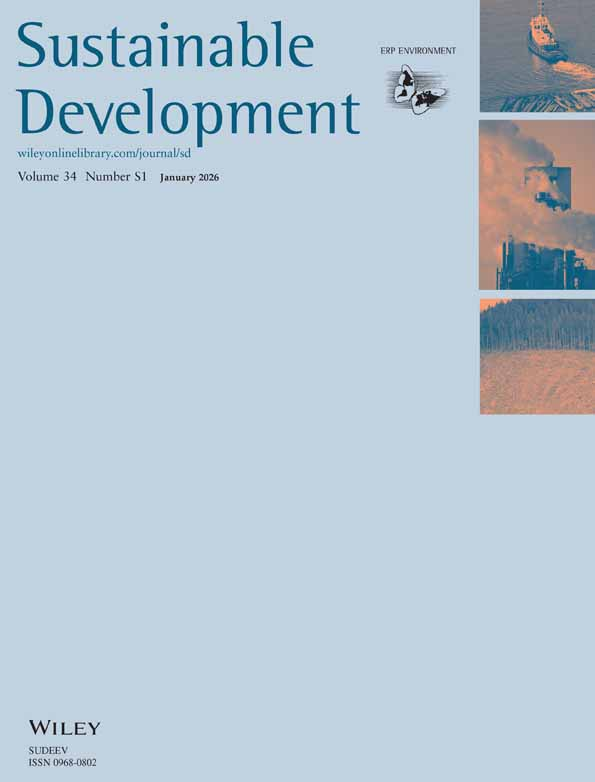
Sustainable Development, published by Wiley in the United States, is a premier journal in the interdisciplinary field of sustainable development. With an Impact Factor of 8.2 in 2024, it currently ranks first in the JCR Development Studies category. The journal focuses on interdisciplinary research in sustainable development theory and practice, wielding significant influence in both academic and policy circles.
ABSTRACT
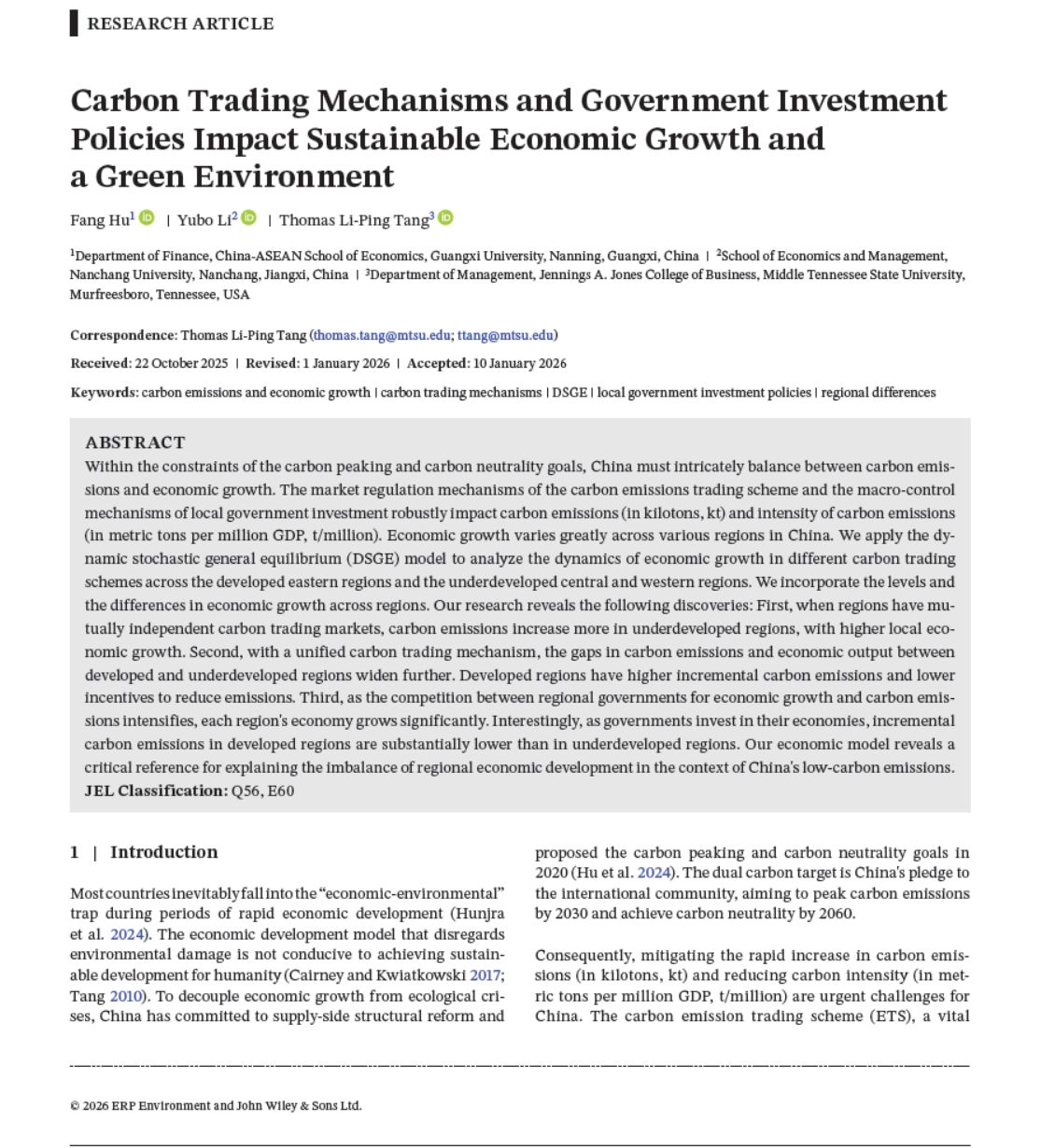
Within the constraints of the carbon peaking and carbon neutrality goals, China must intricately balance between carbon emissions and economic growth. The market regulation mechanisms of the carbon emissions trading scheme and the macro-control mechanisms of local government investment robustly impact carbon emissions (in kilotons, kt) and intensity of carbon emissions (in metric tons per million GDP, t/million). Economic growth varies greatly across various regions in China. We apply the dynamic stochastic general equilibrium (DSGE) model to analyze the dynamics of economic growth in different carbon trading schemes across the developed eastern regions and the underdeveloped central and western regions. We incorporate the levels and the differences in economic growth across regions. Our research reveals the following discoveries: First, when regions have mutually independent carbon trading markets, carbon emissions increase more in underdeveloped regions, with higher local economic growth. Second, with a unified carbon trading mechanism, the gaps in carbon emissions and economic output between developed and underdeveloped regions widen further. Developed regions have higher incremental carbon emissions and lower incentives to reduce emissions. Third, as the competition between regional governments for economic growth and carbon emissions intensifies, each region’s economy grows significantly. Interestingly, as governments invest in their economies, incremental carbon emissions in developed regions are substantially lower than in underdeveloped regions. Our economic model reveals a critical reference for explaining the imbalance of regional economic development in the context of China’s low-carbon emissions.
The China-ASEAN School of Economics has consistently dedicated itself to advancing high-level academic research, encouraging faculty and students to actively engage in domestic and international academic exchanges and collaborations, thereby continuously enhancing their scholarly capabilities and innovative prowess. The successful publication of this research represents the culmination of the school’s long-standing commitment to research investment and talent cultivation. It not only demonstrates our institution’s research strength in the humanities and social sciences and its capacity for interdisciplinary innovation but also further elevates our school’s visibility and influence within the global academic community.
Author Biography

Hu Fang, Associate Professor (New Track) and Master’s Supervisor at the China-ASEAN School of Economics, Guangxi University. Her research focuses on the Green Economy and Sustainable Industrial Development, ASEAN-China Economic and Trade Cooperation, Insurance Theory and Technology. In recent years, she has published over 50 academic papers as first or corresponding author, including in Annals of Tourism Research (ABS-4, CAS TOP), Socio-Economic Planning Sciences (CAS TOP), Finance Research Letters (SSCI, JCR Q1), Asian Perspective, The Theory and Practice of Finance and Economics, Journal of Xiangtan University (Philosophy and Social Sciences), Journal of Hunan University of Science & Technology (Social Science Edition), and Science & Technology Progress and Policy. She has led two projects funded by the National Natural Science Foundation of China (including one completed project with an “Excellent” performance evaluation), one Natural Science Foundation of Guangxi, one Guangxi Philosophy and Social Sciences Research Project, two Guangxi Higher Education Undergraduate Teaching Reform Projects (Level A Projects, including one completed), and one Industry-Academia Collaboration Project for Collaborative Talent Development.
Written by Hu Fang
Proof Read by Yu Na, Chen Yanyang
Edited by Gan Ziying
Reviewed by Gong Zheng


 ADD:No.100 Daxue Road, Nanning, Guangxi, China
 Tel/Fax:+86-0771-3186687
 Email: gse@gxu.edu.cn
 Wechat