Recently, a research team led by Professor Zhang Lin of the School of Economics together with doctoral student Zhang Quanjun and others, with Guangxi University listed as the primary affiliated institution, published an academic paper titled “Knowledge stickiness and technological concentration in the AI industry: an empirical study of Chinese cities” in Scientific Reports, an internationally renowned SCI journal under Nature Portfolio.
Paper Link: https://doi-org-s.vpn.gxu.edu.cn:8118/10.1038/s41598-026-48244-5
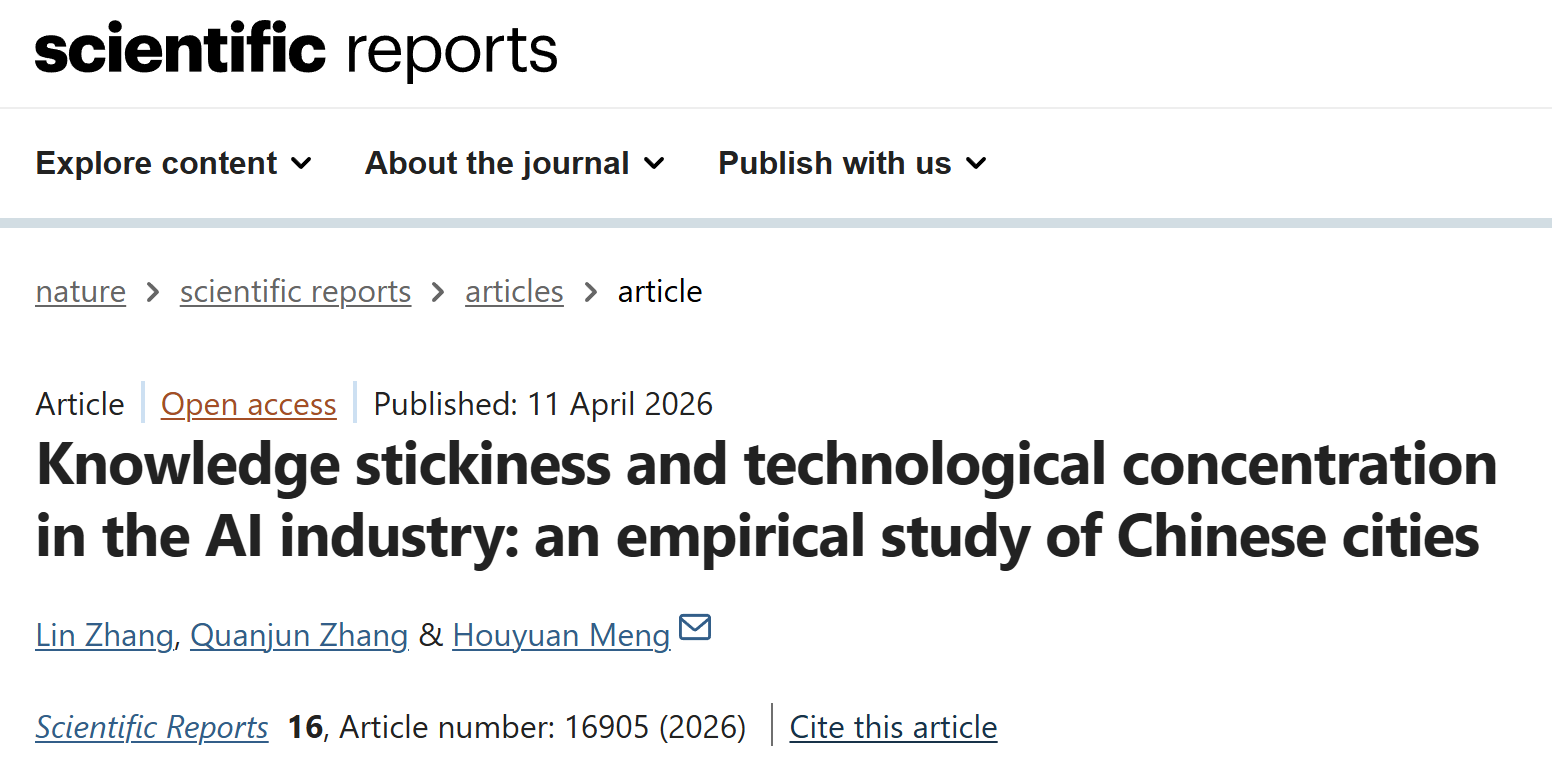
Against the backdrop of artificial intelligence having become a key general-purpose technology driving regional industrial upgrading and technological transformation, the study systematically examines the inherent evolutionary patterns between AI knowledge stickiness and urban technological concentration. Based on a two-dimensional balance between knowledge diffusion and path lock-in, the research team innovatively developed a city-level framework for measuring AI knowledge stickiness and found an inverted U-shaped relationship between knowledge stickiness and technological concentration. Moderate levels of stickiness facilitate technological accumulation, whereas excessive stickiness tends to trigger path lock-in and hinder innovation. Technological complexity significantly moderates this nonlinear relationship by altering its strength and curvature. The nonlinear pattern is more clearly detected in eastern cities and in small and medium-sized cities, while large cities, owing to their diverse knowledge networks and extensive external connections, appear more resilient to high levels of knowledge stickiness.
Scientific Reports is a comprehensive academic journal under Nature Portfolio with significant international influence. It publishes research results across multiple fields such as natural sciences, engineering and technology, medicine, and social sciences, covering numerous research directions including engineering and mathematical sciences, earth and environmental sciences, and life and health sciences. The journal is committed to advancing open science and interdisciplinary integration. It ranks third globally in citations and is among the largest open-access journals by publication volume; it is also ranked in the JCR Q1 quartile.
The work by Professor Zhang Lin’s team has opened up a new pathway for social science research to engage with interdisciplinary scientific inquiry. The publication of this high-level international paper not only provides solid empirical evidence for formulating AI industry policies tailored to local conditions, but is also an important academic achievement of the School of Economics in deeply aligning with Guangxi’s ASEAN-oriented AI development strategy and in serving the construction of the China–ASEAN Digital Silk Road. In the future, the School will continue to anchor itself to Guangxi’s AI development path of “R&D in Beijing, Shanghai and Guangzhou + integration in Guangxi + application in ASEAN,” conduct in-depth research around key issues such as AI-enabled cross-border trade, digital industrial chain coordination, and regional digital governance, work jointly with ASEAN universities and think tanks to tackle key problems, and produce more original results that combine theoretical depth with practical value—so as to support the development of a China–ASEAN AI innovation hub through economics-based research and policy expertise, and to contribute the expertise of higher education institutions to the building of a close-knit China–ASEAN community with a shared future.
Source: Zhang Lin
Translated by AI
Proofread by Yu Na, Fan Shi Qiongxiang
Edited by Gan Ziying
Reviewed by Gong Zheng


 ADD:No.100 Daxue Road, Nanning, Guangxi, China
 Tel/Fax:+86-0771-3186687
 Email: gse@gxu.edu.cn
 Wechat