On September 3, the 10th China Frontier Economic Opening and Development Forum was held in Yanji, Yanbian Korean Autonomous Prefecture, Jilin Province. Themed “Promoting High-Quality Development of Frontier Economies and Accelerating the Development of an Independent Knowledge System of Frontier Economics in China,” the forum brought together more than 130 participants, including officials from relevant national ministries and commissions and frontier provinces and regions, as well as experts and scholars from related fields across China. Participants explored new pathways for the opening-up and development of frontier economies in the new era.
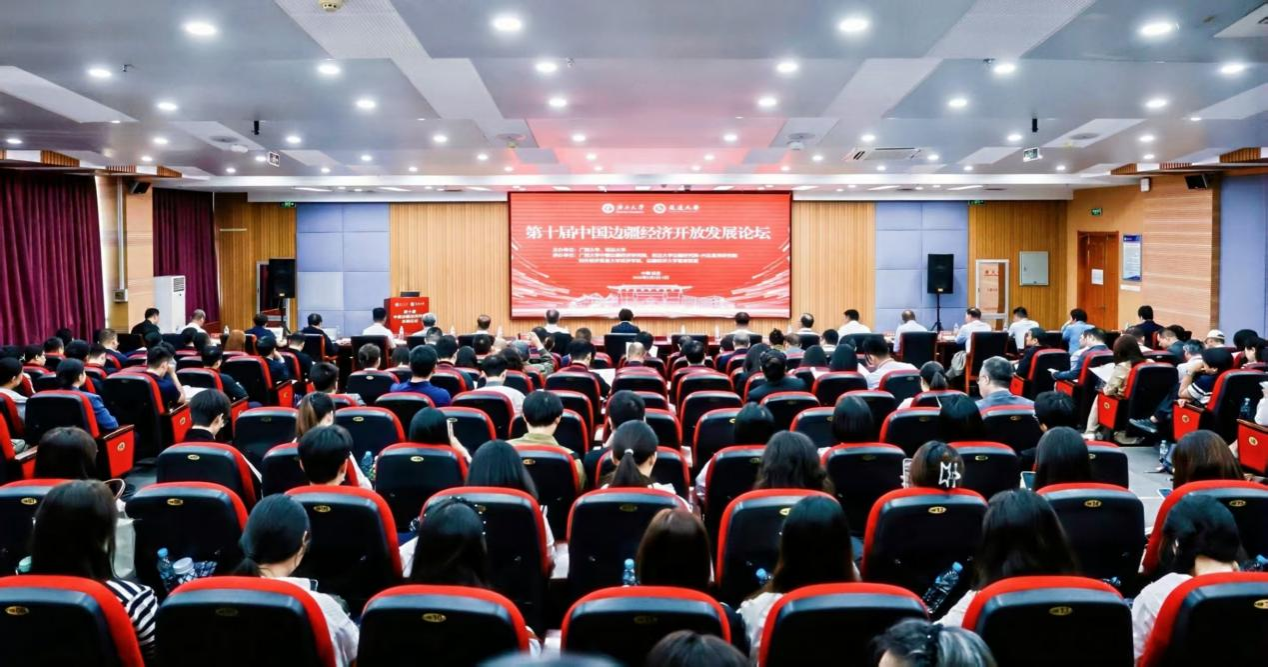
At the opening ceremony, Qian Keming, Member of the Standing Committee of the National Committee of the Chinese People's Political Consultative Conference (CPPCC), Vice Chairman of the Committee on Education, Science, Health and Sports, Chairman of the National Steering Committee for Graduate Education in International Business, and former Vice Minister of Commerce; Wang Naixue, Vice Chairman and Party Group Member of the CPPCC Guangxi Committee; Gao Yuanyuan, President of the China Association of International Economic Cooperation; and Zheng Quan, Party Group Member and Vice Governor of Yanbian Korean Autonomous Prefecture, delivered speeches as guest representatives. Xu Huarui, Party Secretary of Guangxi University, and Liu Yan, Member of the Standing Committee of the Party Committee and Vice President of Yanbian University, delivered speeches on behalf of the host universities.
Qian Keming noted that China's frontier regions serve as important gateways for opening up to the outside world. Over the past ten editions, the forum has developed into an important platform for academic exchange and policy consultation in the field of frontier economic research in China. He spoke highly of the valuable initiatives undertaken by the China Frontier Economic Research Institute of Guangxi University, including the development of the Frontier Economic University Think Tank Alliance and the Big Database of Frontier Economics, household surveys in frontier regions, and the Annual Report on China's Frontier Economic Opening and Development. He expressed the hope that participating experts and scholars would demonstrate academic responsibility in advancing frontier development, contribute academic wisdom to industrial development and improving people's livelihoods, and deepen their academic commitment to serving the well-being of the people.
Wang Naixue stated that the forum was of significant theoretical and practical value. He called for greater emphasis on theoretical innovation and new breakthroughs in developing an independent knowledge system of frontier economics in China; a problem-oriented approach to serving the high-quality development of frontier regions through high-quality research; and deeper collaboration to transform the brand strength accumulated over the forum's ten editions into a development advantage for the frontier research community.
Gao Yuanyuan called for deeper collaboration among universities, academic associations, and think tanks, with a focus on the port economy, cross-border industrial and supply chains, and institutional innovation. He also stressed the need to strengthen strategic policy advisory services and cross-regional exchanges to better support the high-quality development of frontier regions.
Zheng Quan noted that Yanbian Korean Autonomous Prefecture, located at the junction of China, Russia, and the DPRK, serves as an important gateway for opening up in Northeast Asia. Leveraging the Hunchun Marine Economic Development Demonstration Zone and the Comprehensive Bonded Zone, Yanbian is promoting a transition from a “corridor economy” to a “port economy.” He expressed the hope that the forum would contribute insights and recommendations for the development of Yanbian Korean Autonomous Prefecture.
Xu Huarui introduced Guangxi University's distinctive strengths in education and research related to frontier and ethnic studies. He stated that the University would continue to support the Institute in deepening coordination and collaboration, strengthening its role as a leading think tank for frontier development, accelerating the development of an independent theoretical system for frontier studies in China, and integrating talent cultivation with frontier development to nurture a new generation of talent for the development of China's frontier regions.
Liu Yan noted that Yanbian University is deeply rooted in China's frontier region and would further deepen cooperation, strengthen research on major issues, and contribute to the prosperity and stability of frontier regions.
Li Guanghui, Dean of the China Frontier Economic Research Institute of Guangxi University, Vice President of the China Association of International Economic Cooperation, and Director of its Frontier Economic Specialized Committee, and Zhang Jie, Executive Dean of the Institute of Regional and Country Studies at Yanbian University, delivered keynote reports. They shared forward-looking insights on topics including theoretical innovation in frontier economics, Northeast Asian regional cooperation, and the opening up of frontier regions.
Six experts and scholars—Qu Weixi, Zhang Zhiming, Sang Baichuan, Li Junqing, Zhang Xufeng, and Sun Yong—delivered thematic reports, presenting their latest research findings on high-level opening up during the 15th Five-Year Plan period, cross-border economic cooperation, multinational corporations’ investment in China, frontier governance, the development of port supply chains, and the theoretical development of frontier economics.
The parallel forums featured in-depth exchanges and discussions on four major themes: “Cultivating New Quality Productive Forces and Developing a Modern Industrial System in Frontier Regions,” “Institutional Opening Up of Frontier Economies and Integration into the Unified National Market,” “Developing the Theoretical System of Frontier Economics and Advancing the Practice of Vitalizing Border Areas and Enriching the People,” and “Forging a Strong Sense of Community for the Chinese Nation and Promoting Ethnic Unity and Progress in Frontier Regions.” Participants offered insights and recommendations for promoting the high-quality development of frontier economies.
During the forum, the 2026 Annual Report on China's Frontier Economic Opening and Development, edited by Li Guanghui, was released, and a handover ceremony for the 11th China Frontier Economic Opening and Development Forum was held.
At the closing ceremony, Tang Zhihua, Deputy Secretary of the Party Committee of Guangxi University, noted that the forum featured high-level participation, broad coverage, and substantial outcomes, providing valuable insights and practical approaches for modernizing frontier governance and advancing the development of an open economy in the new era.
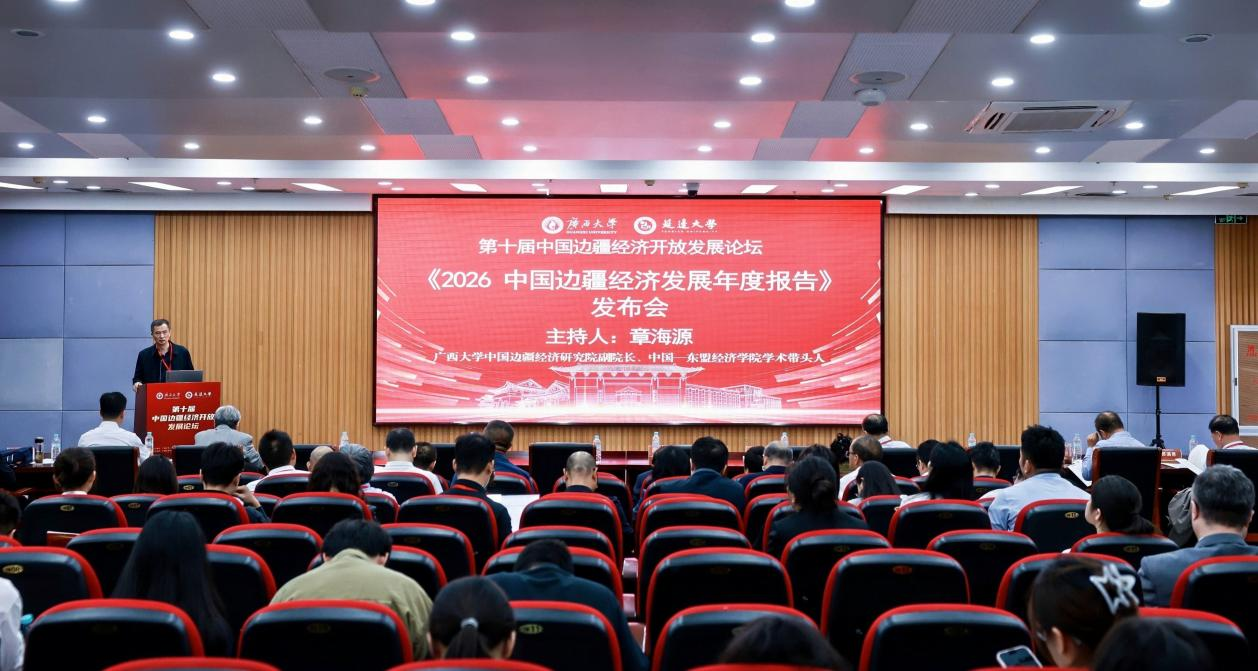
The China Frontier Economic Opening and Development Forum has been held for ten editions and has gradually become one of the most influential forums in China dedicated to promoting the development of frontier economies. Since 2017, the forum has been held in Beijing and a number of frontier provinces and regions, with the Annual Report on China's Frontier Economic Opening and Development released on a continuous basis. It has helped build a nationwide collaborative network for frontier economic research, established a two-way communication bridge between research and policy implementation, and deepened the exchange of ideas on cross-border regional cooperation.
Source: Yang Ziqing, Wu Fan
Translated by AI
Proofread by Yu Na, Fan Shi Qiongxiang
Edited by Wei Jiali
Reviewed by Gong Zheng


 ADD:No.100 Daxue Road, Nanning, Guangxi, China
 Tel/Fax:+86-0771-3186687
 Email: gse@gxu.edu.cn
 Wechat