An academic paper "How regional trade policy uncertainty affects agricultural imports from third countries: Evidence from the China-ASEAN Free Trade Area" co-authored by the School's faculty member Qin Cheng as co-first author and collaborators was officially published in Frontiers in Sustainable Food Systems. The study was jointly funded by the China-ASEAN Regional Development Collaborative Innovation Center Fund Project of Guangxi Higher Education Humanities and Social Sciences Key Research Base and the 2024 Policy Research Project of Guangxi University School of Economics.
About the Paper
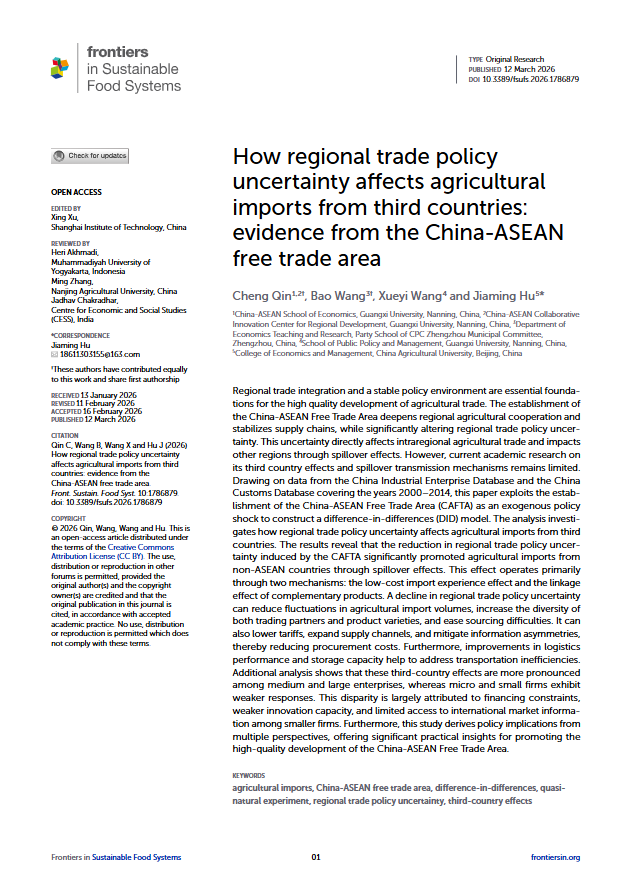
Against the backdrop of profound adjustments in the global trade landscape, deepening regional economic integration, and agriculture trade becoming a core area of international economic and trade cooperation, the establishment of the China-ASEAN Free Trade Area has enhanced regional agricultural cooperation, stabilized agricultural product supply chains, and significantly reduced the level of uncertainty in regional trade policies. It not only impacts agricultural trade within the region but also exerts spillover effects on third-party countries. However, existing research on these third-party effects and spillover transmission mechanisms remains limited. To address this research gap, the team used the establishment of the China-ASEAN Free Trade Area as an exogenous policy shock, leveraging micro-level data from the China Industrial Enterprises Database and China Customs Database covering 2000-2014. By constructing a difference-in-differences (DID) model, they systematically investigated the impact effects, mechanisms, and heterogeneous characteristics of regional trade policy uncertainty on China's agricultural imports from third-party countries, providing a novel agricultural trade perspective for understanding the spillover effects of regional trade cooperation.
The study achieved several significant innovative outcomes and research findings: First, it broke through the existing paradigm of regional trade policy uncertainty research, which predominantly focused on bilateral relations, and for the first time empirically verified from the perspective of agricultural imports that the reduction in regional trade policy uncertainty brought by the China-ASEAN Free Trade Area would significantly promote China's agricultural imports from non-ASEAN countries through spillover effects. This confirms the existence of third-party effects in agricultural imports within regional trade cooperation, filling the gap in research on third-party effects in agricultural trade and providing empirical evidence for the diversified and interconnected development of cross-border agricultural trade networks. Second, it innovatively identified two core transmission mechanisms by which regional trade policy uncertainty affects third-party agricultural imports—the low-cost import experience effect and complementary product linkage effect—clarifying how regional trade policy stabilization promotes agricultural trade between China and non-ASEAN countries by accumulating import management experience and strengthening complementary demand in industrial chains, thereby deepening theoretical understanding of the transmission pathways of regional trade policy uncertainty. Third, it systematically analyzed the economic impacts of this third-party effect and the heterogeneity characteristics of enterprises, finding that reduced regional trade policy uncertainty can alleviate procurement challenges for China's agricultural imports, lower procurement costs, and improve transportation efficiency. This effect is more pronounced among large and medium-sized enterprises, while small and micro enterprises exhibit weaker responses to policy dividends due to factors such as financing constraints, weak innovation capabilities, and insufficient access to international market information. Meanwhile, the study also analyzes the supporting role of the flexibility of China-ASEAN Free Trade Area's rules of origin on third-party effects from the institutional background perspective, providing a new perspective for understanding the correlation between the institutional design of regional trade agreements and trade spillover effects.
About the Journal
Frontiers in Sustainable Food Systems is a leading international journal (SCI Zone 2) in the field of sustainable food systems. It focuses on cutting-edge research areas including agricultural trade, food supply chains, regional agricultural cooperation, and sustainable agricultural development. The journal publishes research findings that combine theoretical depth with practical value, providing crucial academic references for the high-quality development of global agricultural economies and food systems. It enjoys extensive international influence in the fields of agricultural economics and sustainable development studies.
About the Author

Qin Cheng, Ph.D. in Economics, is an Assistant Dean and Assistant Professor at the China-ASEAN School of Economics/College of Economics/China-ASEAN School of Financial Cooperation, Guangxi University, specializing in China-ASEAN and frontier economy research. In recent years, he has published over 60 papers in SSCI and CSSCI academic journals such as China Agricultural Economic Review, Digital Health, Frontiers in Public Health, China Rural Observation, Agricultural Economic Issues, Resource Science, and Modern Japanese Economy. He has also authored more than 10 signed articles in renowned publications and websites including Guangming Daily (Theoretical Edition), Guangming Net Academic Channel, China Population News, China Financial News, Rural Work Communications, and Guangxi Daily (Theoretical Edition). His policy advisory reports have been adopted or endorsed by the General Office of the CPC Central Committee, the General Office of the State Council, the Central Rural Work Leading Group Office, the Ministry of Agriculture and Rural Affairs, the Ministry of Education, the Ministry of Commerce, and the Guangxi Party Committee and Government. He has received the Central Rural Work Leading Group Office and the Ministry of Agriculture and Rural Affairs' Outstanding Achievement Award in Soft Science, as well as the China Agricultural Resources and Regional Planning Society Science and Technology Award.
Written by Qin Cheng
Translated by AI
Proofread by Yu Na, Chen Yanyang
Edited by Gan Ziying
Reviewed by Gong Zheng


 ADD:No.100 Daxue Road, Nanning, Guangxi, China
 Tel/Fax:+86-0771-3186687
 Email: gse@gxu.edu.cn
 Wechat